A home organization system is often misunderstood as a way to arrange things.
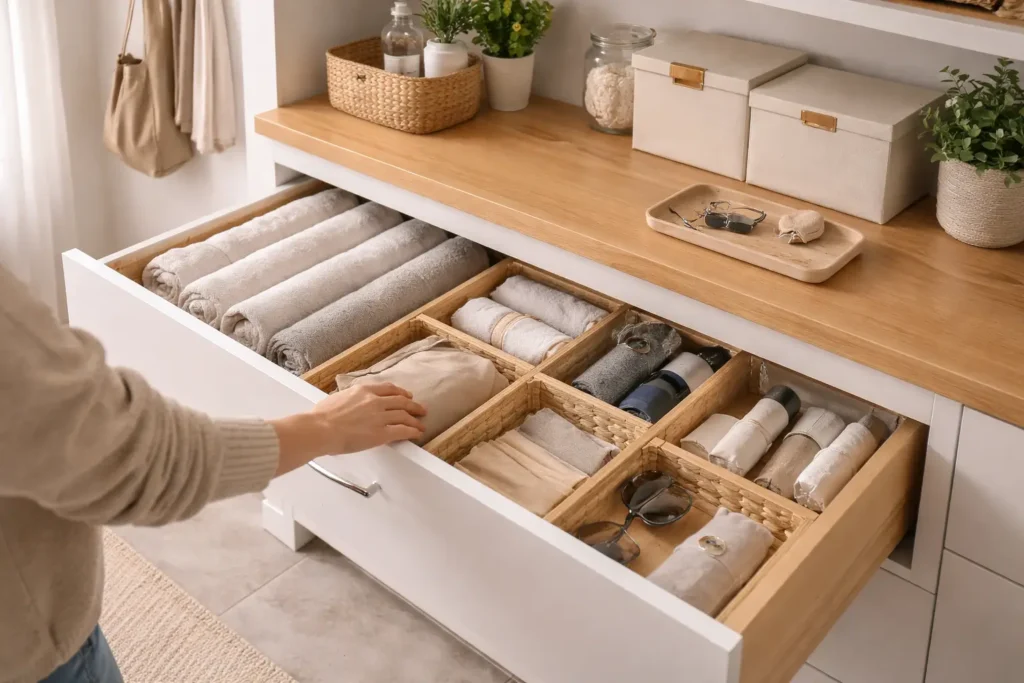
In reality, it defines how a home functions on a daily basis.
Without a clear system, organization depends on effort.
With a system, organization becomes part of how the space operates.
This difference explains why some homes stay consistent while others require constant correction.
Why Organizing Alone Doesn’t Last
Many people organize their homes repeatedly.
They:
- declutter
- rearrange
- create storage solutions
For a short time, everything looks controlled.
But the result does not hold.
This happens because organizing focuses on placement, not behavior.
When the way a space is used is not aligned with how it is organized, the structure breaks down.
This is the same pattern explained in why cleaning never lasts, where repeated effort replaces structural support instead of producing lasting results.
What a Home Organization System Actually Does in Daily Life
A home organization system is not just about where items go.
It defines:
- how items move
- where they are used
- how easily they return
- how the space resets
When these elements are clear, maintaining order requires less effort.
Without them, every action becomes a decision.
The Problem With Effort-Based Organization
When organization depends on effort:
- consistency fluctuates
- tasks repeat
- maintenance becomes heavier
This creates a cycle:
organize → lose control → reorganize → repeat
This is closely related to what is described in why my home never feels organized, where repeated effort fails to create a consistent sense of order over time.
The issue is not lack of discipline.
It is the absence of a structure that supports daily use.
How Daily Behavior Shapes Your Space
Everyday actions influence how a home evolves.
Small behaviors such as:
- placing items temporarily
- moving objects between rooms
- leaving things in high-use areas
create patterns over time.
These patterns are predictable.
This is also closely related to what is described in why my home never feels organized, where misalignment between daily behavior and structure prevents the space from feeling consistently organized.
The Core Elements of an Effective Home Organization System
A functional home organization system is built on a few essential components.
1. Placement That Reflects Real Use
Items should be stored where they are naturally used.
When placement aligns with behavior:
- movement becomes efficient
- items return more easily
- clutter builds more slowly
2. Low Friction
Friction determines whether an action will happen consistently.
High friction:
- increases effort
- reduces consistency
Low friction:
- simplifies actions
- supports repetition
3. Clear Return Paths
Every item should have a clear and accessible place to return.
If returning an item requires:
- multiple steps
- decision-making
- extra effort
it is less likely to happen.
4. Continuous Reset
A system must include a way to maintain itself.
Instead of relying on periodic cleaning, small resets help preserve order.
At this point, the difference becomes clearer.
Applying a structured reset approach can make it easier to manage high-use areas without increasing how often you clean.
A Practical Insight (Transition to System)
At this stage, the limitation of isolated actions becomes visible.
Organizing alone is not enough.
Cleaning alone is not enough.
What creates consistency is how these actions are connected.
In many cases, this becomes easier when supported by a structure such as a daily reset system, where small, consistent resets help maintain stability across different areas.
Why Some Systems Fail
Not every system works effectively.
A system fails when it:
- does not reflect real behavior
- introduces complexity
- requires constant attention
An effective system should:
- be simple
- be intuitive
- support daily patterns
How to Build a Simple Home Organization System
You do not need to redesign your entire home.
Start with one area.
Step 1: Observe Movement
Identify:
- where items are used
- how they move
- where clutter forms
Step 2: Adjust Placement
Move items closer to where they are needed.
Reduce unnecessary movement.
Step 3: Simplify Storage
Make storage:
- easy to access
- easy to use
- easy to maintain
Step 4: Add a Reset Layer
Introduce a small reset that maintains the system over time.
This prevents accumulation.
If you want to apply this in a more complete way, this becomes much clearer when structured as a full system, as explained in how to keep your house clean without effort, where small adjustments connect to create long-term stability.
What Changes When the System Is Working
When a home organization system is aligned with daily use:
- clutter builds more slowly
- cleaning becomes less frequent
- effort becomes more consistent
The home does not stay perfect.
But it remains stable.
This becomes even more effective when organization is supported without relying on constant cleaning, as explained in how to keep home organized without cleaning, where structure reduces the need for repeated effort.
Conclusion: What Actually Keeps a Home Organized
A home organization system is not about creating order once.
It is about maintaining it continuously.
When structure supports behavior:
- fewer decisions are required
- actions become easier
- results last longer
A practical system like a daily reset system can help stabilize these patterns by supporting how your space is used daily and reducing the need for repeated effort.