Why does my house get messy so fast? If you feel like you’re constantly cleaning but your home quickly falls back into clutter, the problem is usually not effort.
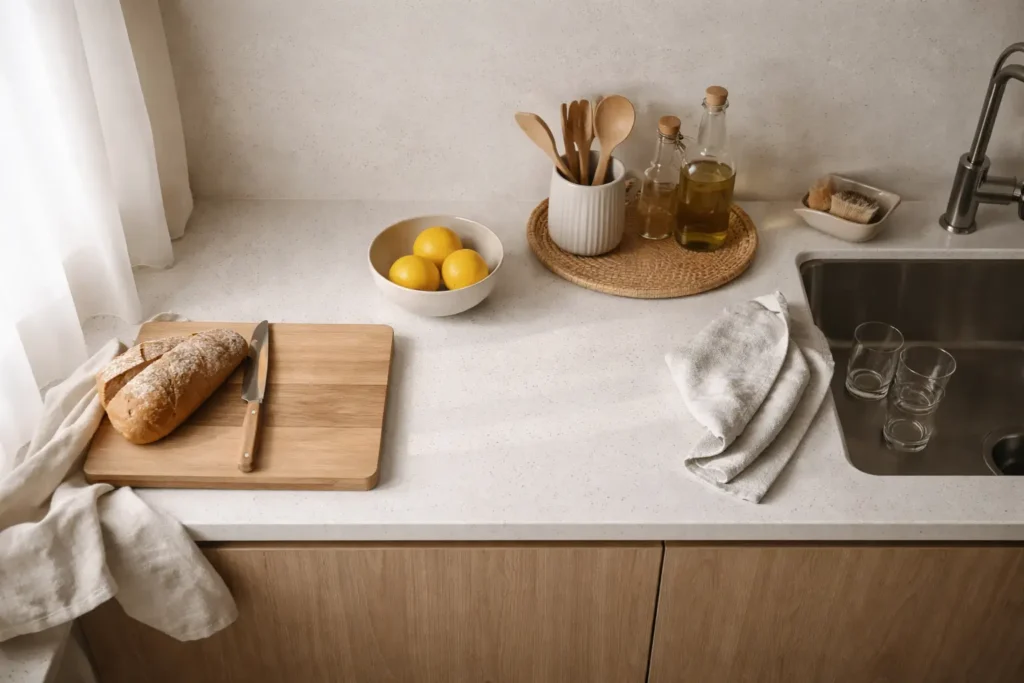
It’s what happens after daily use.
Most homes don’t become messy because people are careless or unmotivated. They become messy because everyday behavior is not supported by a simple system that can maintain order over time.
Once you understand this shift, the situation becomes much easier to solve—and much less frustrating.
Why Does My House Get Messy So Fast? The Real Pattern Behind It
Mess is not random. It follows predictable patterns.
Every object that ends up out of place is influenced by three simple factors:
- how easy it is to access
- how convenient it is to place
- how difficult it is to return
People naturally follow the path of least resistance. If putting something away requires more effort than leaving it out, it will be left out.
Over time, this creates repeated zones of clutter.
This is why the same areas—like kitchen counters, dining tables, or chairs—collect items again and again. These are not signs of disorganization. They are signals that the system in that space is not aligned with real behavior.
The Behavior Loop That Keeps Creating Mess
To understand why your house gets messy so fast, you need to look at the underlying loop.
1. Use Without a Defined Return Path
Items are used throughout the day, but there is no clear or effortless system for putting them back.
2. Temporary Placement Becomes Default Storage
Objects are placed “just for now” on visible surfaces:
- countertops
- tables
- chairs
These temporary decisions quickly become permanent patterns.
3. Accumulation Creates Visual Disorder
As items build up, the space starts to feel chaotic—even if it’s not technically dirty.
4. Cleaning Resets the Surface (But Not the System)
Cleaning removes visible clutter, but it doesn’t change the behavior that created it.
So the cycle repeats.
Why Cleaning Doesn’t Solve the Problem
Cleaning is reactive. It addresses what already happened.
It removes visible clutter, but maintaining is what prevents the need to repeat the same process, as explained in cleaning vs maintaining a home.
But the issue isn’t the mess itself—it’s the system that allows it to happen repeatedly.
This is closely connected to patterns explained in why cleaning never lasts, where repeated effort replaces structure instead of supporting it.
Without changing:
- where things belong
- how easy they are to return
- how often the space is reset
Cleaning becomes an endless loop.
If your house keeps getting messy, it’s not because you’re doing something wrong. It’s because your environment isn’t designed to support consistency.
A Small Shift That Changes Everything
If you’ve tried cleaning routines that never seem to stick, the issue is rarely effort—it’s usually the absence of a simple system.
Instead of adding more tasks, the goal is to reduce friction.
A quick way to start is by introducing a minimal daily structure that keeps things from building up in the first place.
This becomes much clearer when applied as a complete structure, as explained in how to keep your house clean without effort.
This pattern also becomes easier to recognize in everyday situations, as shown in why does my house get messy again so quickly, where repeated daily behaviors recreate the same outcome over time.
The Real Cause: Friction in Daily Use
Mess builds up fastest in areas where friction is highest.
Friction appears when:
- storage is too far from where items are used
- systems are unclear or inconsistent
- putting things away requires extra steps
Even small inefficiencies create resistance.
And resistance leads to shortcuts.
Shortcuts lead to clutter.
A System-Based Approach (Instead of More Effort)
Instead of trying to increase discipline, the goal is to make order easier than disorder.
A well-structured home works with your behavior—not against it.
The Daily Stability Framework
To reduce mess consistently, your home needs three elements:
1. Proximity-Based Placement
Store items close to where they are actually used.
Not based on appearance—but on function.
2. Low-Effort Return
Putting something away should require:
- minimal time
- minimal movement
- minimal decision-making
If it feels inconvenient, it won’t happen consistently.
3. A Consistent Reset Point
A short daily reset prevents accumulation.
This is often implemented through a daily reset system, where the home returns to a baseline state in a predictable and manageable way without requiring deep cleaning.
How to Apply This Without Reorganizing Everything
You don’t need to overhaul your entire home.
Start with the areas that accumulate mess the fastest.
Step 1: Identify High-Impact Zones
Look for places where clutter appears repeatedly.
Step 2: Observe Behavior
Instead of focusing only on space, ask:
- what is being used here?
- why is it staying here?
- what makes it difficult to return?
Step 3: Adjust the Environment
Change the setup—not the habit.
- move items closer
- simplify storage
- remove unnecessary steps
Step 4: Introduce a Daily Reset
Create a short reset routine:
- same time each day
- same sequence
- minimal effort
This prevents buildup before it becomes visible clutter.
Why This Feels Worse in Small Spaces
In smaller homes or apartments, mess becomes visible faster.
- fewer surfaces → quicker accumulation
- less storage → more pressure on systems
- less margin → faster visual impact
But the advantage is also greater.
When systems are aligned, small spaces are easier to maintain with less effort.
Why the Problem Keeps Coming Back
If your home keeps getting messy, it’s not because:
- you lack discipline
- you’re not trying hard enough
- you need better cleaning habits
It’s because the system supporting your daily life is incomplete.
This connects directly to patterns where the root issue is structural rather than behavioral.
A More Sustainable Way to Maintain Order
A stable home does not depend on constant effort.
It depends on alignment.
Alignment between:
- how you move through your space
- where things are stored
- how easy it is to reset
When these elements work together, order becomes automatic.
Not forced.
Conclusion: It’s Not About Doing More
If you’ve been asking “why does my house get messy so fast,” the answer is not that you need to clean more or try harder.
The real issue is that your home is not structured to support your daily behavior.
Once you shift from effort-based cleaning to a simple system:
- mess slows down
- effort decreases
- consistency improves
At that point, you’re no longer constantly fixing the same problem—you’re maintaining control.
If your home keeps getting messy shortly after cleaning, the issue is often not effort—but what happens after daily use. The 5-Minute Daily Reset gives you a simple way to prevent this buildup in just a few minutes a day, without needing to start over each time.