To keep home organized without cleaning, you don’t need to increase effort—you need to reduce the need for it.
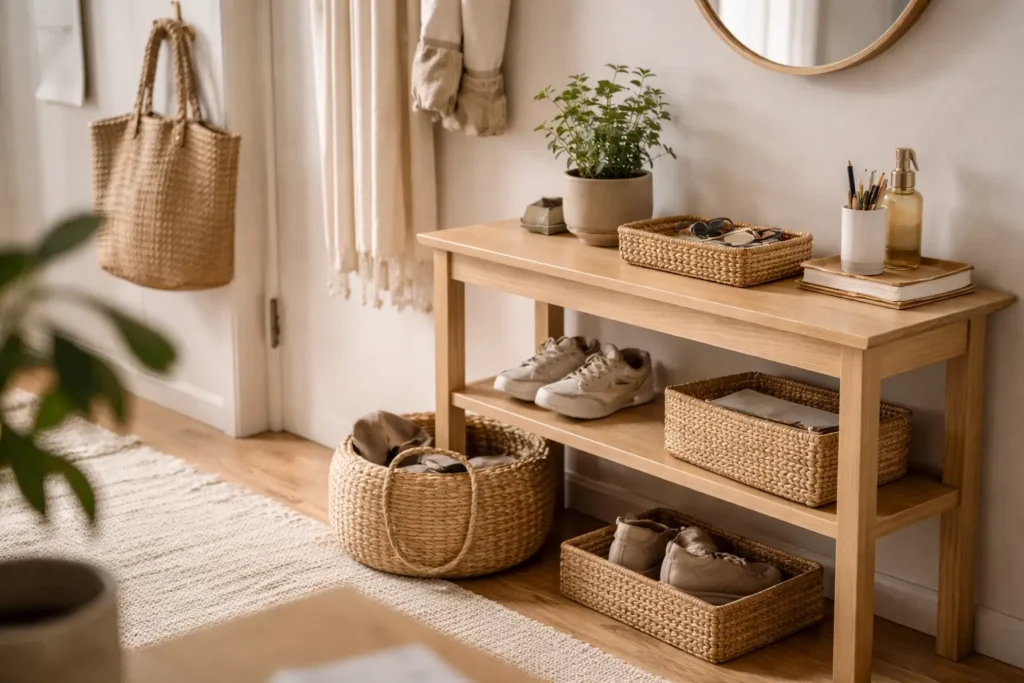
Most people assume that staying organized requires constant maintenance. Cleaning, reorganizing, and resetting spaces repeatedly becomes the default strategy.
But this approach creates a cycle.
You restore order, lose it again, and then repeat the process.
The issue is not how often you clean.
It is how your home behaves between those moments.
Why Cleaning More Does Not Lead to Organization
Cleaning and organizing are often treated as the same thing.
They are not.
Cleaning restores order temporarily. Organization determines whether that order lasts.
When a home depends on cleaning to stay functional, it is operating in a reactive mode.
This is the same dynamic seen in cleaning failure, where repeated effort does not create stability.
Without structural support, cleaning becomes maintenance for a system that is not working.
What Actually Causes Disorder to Return
After a space is cleaned, daily use begins immediately.
Objects move. Surfaces are used. Tasks interrupt routines.
If the environment does not support these actions, small disruptions remain unresolved.
Over time, these unresolved actions accumulate.
This is how a messy home develops—not from neglect, but from repeated misalignment between how the space is used and how it is organized.
Keep Home Organized Without Cleaning by Changing What Happens Between Tasks
To keep home organized without cleaning, the focus needs to shift from large actions to small, continuous alignment.
The key question becomes:
What happens after you use a space?
If nothing returns the environment to its baseline, disorder will always reappear.
Organization is not created during cleaning.
It is maintained between uses.
The Structural Gap Most Homes Have
Most homes lack a mechanism that resets small disruptions.
They rely on:
- Memory
- Motivation
- Available time
These are inconsistent.
As a result:
- Tasks are postponed
- Items remain out of place
- Surfaces begin to accumulate clutter
This gap is what turns normal daily activity into ongoing disorder.
Why Deep Cleaning Feels Necessary (But Isn’t the Real Solution)
Deep cleaning becomes necessary when accumulation reaches a threshold.
At that point:
- The space is no longer functional
- Tasks take longer to complete
- Visual clutter creates friction
Cleaning at this stage is not maintenance.
It is recovery.
And recovery requires significantly more effort than prevention.
A Different Approach: Stabilizing Instead of Resetting Everything
Instead of relying on deep cleaning, a more effective approach is to stabilize the environment continuously.
This means:
- Managing small disruptions early
- Keeping key areas functional
- Avoiding accumulation
This does not require more time.
It requires a different structure.
How a Daily Reset Supports Ongoing Organization
A simple way to maintain stability is through a daily reset system.
Rather than cleaning everything, it focuses on:
- Restoring key surfaces
- Returning misplaced items
- Preparing the space for the next cycle of use
Because it is limited and predictable, it avoids becoming a full cleaning routine.
It acts as a stabilizer.
Mid Insight
A simple system, such as a daily reset method, can help reduce repetition by creating a clear and consistent way for your home to return to baseline.
Why This Works Even in Busy Routines
A system that requires minimal effort can be sustained under real conditions.
Unlike deep cleaning, it does not depend on:
- Large blocks of time
- High energy
- Perfect consistency
Instead, it works because:
- It is short
- It is repeatable
- It aligns with daily use
This allows organization to persist without requiring constant intervention.
What Changes When Cleaning Is No Longer the Primary Tool
When you shift away from cleaning as the main solution:
- Disorder accumulates more slowly
- Maintenance becomes lighter
- The home remains closer to baseline
This reduces the need for major resets.
Instead of reacting to problems, you prevent them from forming.
Practical Adjustments That Reduce the Need for Cleaning
To support this approach, small structural changes can be introduced:
1. Reduce surface overload
Limit how many functions a surface serves.
2. Align storage with frequency of use
Frequently used items should be the easiest to return.
3. Simplify decision points
Reduce the number of steps required to complete an action.
4. Protect high-use areas
Focus on entryways, kitchens, and living spaces.
These adjustments reduce friction.
This becomes much easier to sustain when supported by simple daily actions, as shown in daily habits to keep house clean, where small, consistent behaviors help maintain order without requiring constant effort.
And when friction is reduced, maintenance becomes easier.
Keep Home Organized Without Cleaning Through Daily Alignment
The ability to keep home organized without cleaning depends on how well the environment supports everyday activity.
If daily actions are absorbed quickly, disorder cannot accumulate.
If they are not, cleaning becomes necessary.
Organization is not a result of effort.
It is a result of alignment.
Final Thought
When a reset structure is in place, maintaining order becomes more consistent without adding complexity to your routine.