Stop cleaning same mess everyday becomes frustrating when the problem repeats no matter how often you clean. You organize, reset, and clear surfaces, but the same clutter returns again and again.
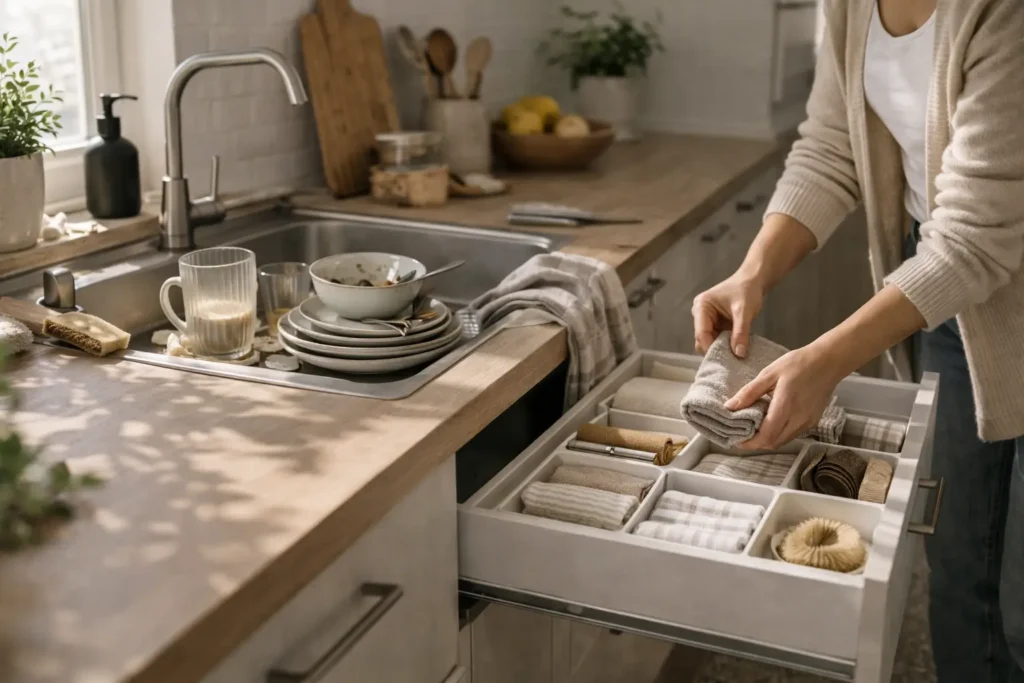
The issue isn’t that you didn’t clean well.
It’s that nothing changed in how the space behaves after.
Why the Same Mess Keeps Coming Back
Most daily mess is not random.
It follows patterns.
For example:
- items used frequently stay out longer
- surfaces become temporary holding areas
- objects move without being fully returned
These patterns repeat every day.
That’s why the same mess comes back in the same places.
This is closely related to what happens in why does my house get messy so fast, where daily use creates predictable patterns of clutter.
Stop cleaning same mess everyday starts with understanding the pattern
Stopping the repetition is not about cleaning more.
It starts by observing:
- where clutter builds first
- which items are involved
- when the breakdown happens
Without understanding the pattern, cleaning becomes reactive.
The Real Problem: Cleaning Without Structural Change
Cleaning removes what is visible.
But it doesn’t change what caused it.
If nothing changes in:
- placement
- access
- return process
the same mess will return.
This is the same dynamic explained in why cleaning never lasts, where repeated effort replaces structural support instead of maintaining results.
Why Daily Cleaning Turns Into a Loop
The cycle usually looks like this:
clean → use → clutter → clean again
This is closely connected to what is described in cleaning routine not working, where repeated effort fails to interrupt the cycle due to the absence of a consistent structure.
This loop continues because:
items are not returned consistently
surfaces are reused without reset
there is no defined endpoint
Without structure, the system resets itself randomly.
The Hidden Role of High-Use Areas
Some areas create most of the repetition:
- kitchen counters
- entry surfaces
- workspaces
These areas are constantly active.
If they are not stabilized, they generate daily mess.
A Practical Example
Imagine a kitchen counter used throughout the day.
You place:
- groceries
- utensils
- cups
At the end of the day, you clean it.
But during the next day, the same behavior repeats.
Nothing changed in how the space supports use.
Why Effort Alone Doesn’t Solve It
Trying harder increases effort, not stability.
When maintenance depends on:
- motivation
- time
- attention
it becomes inconsistent.
This is why cleaning the same mess becomes a daily task.
This often connects to a deeper pattern, as explained in why I never finish cleaning, where tasks are started but rarely completed due to lack of structure and clear endpoints.
The Shift: From Cleaning to Control
At some point, the solution changes direction.
Instead of asking:
“How do I clean this better?”
The question becomes:
“How do I stop this from happening again?”
That shift leads to structure.
Applying a structured reset approach can make it easier to manage high-use areas without increasing how often you clean.
What Actually Stops the Repetition
To stop cleaning the same mess, something must change in how the space resets.
This usually involves:
- reducing friction
- simplifying return
- creating consistent checkpoints
These adjustments reduce accumulation before it becomes visible.
The Role of a Daily Reset Structure
A daily reset structure introduces a predictable way for your home to return to baseline.
Instead of waiting for disorder to build:
- small resets happen consistently
- items return faster
- surfaces stay aligned
A daily reset structure introduces a consistent way for your home to return to baseline. A practical approach helps align daily use with how items return and prevents repeated buildup.
How to Apply This in Real Life
You don’t need a full overhaul.
Start with one area.
Step 1: Identify the Repeating Mess
Choose a space where:
- clutter returns daily
- cleaning feels repetitive
Step 2: Simplify the Return Process
Ask:
- where should this go?
- how easy is it to return?
If it’s not easy, it won’t happen consistently.
Step 3: Add a Reset Point
Create a simple moment in your routine where:
- items are returned
- surfaces are cleared
- space is prepared
Step 4: Keep It Short
5–10 minutes is enough.
Consistency matters more than intensity.
What Changes When You Apply This Approach
When the structure changes:
- mess builds more slowly
- cleaning becomes less frequent
- effort becomes predictable
The space begins to maintain itself between cleaning sessions.
Why This Works Long Term
The difference is not the cleaning.
It’s the system behind it.
When a space supports daily behavior:
- actions become easier
- decisions decrease
- results last longer
Conclusion: How to Stop Cleaning the Same Mess Every Day
To stop cleaning the same mess everyday, the focus needs to shift from cleaning to structure.
When nothing changes in how your home functions:
- the same patterns repeat
- the same mess returns
- the same effort is required
But when a simple structure supports daily use:
- repetition decreases
- maintenance becomes easier
- results last longer
When a simple structure such as a daily reset system is in place, maintaining order becomes more consistent and reduces the need to clean the same mess repeatedly.