A kitchen rarely becomes messy all at once.
Instead, it shifts gradually. A clean surface starts to collect items. A small action is left incomplete. Another follows. By the end of the day, the space no longer reflects how it started.
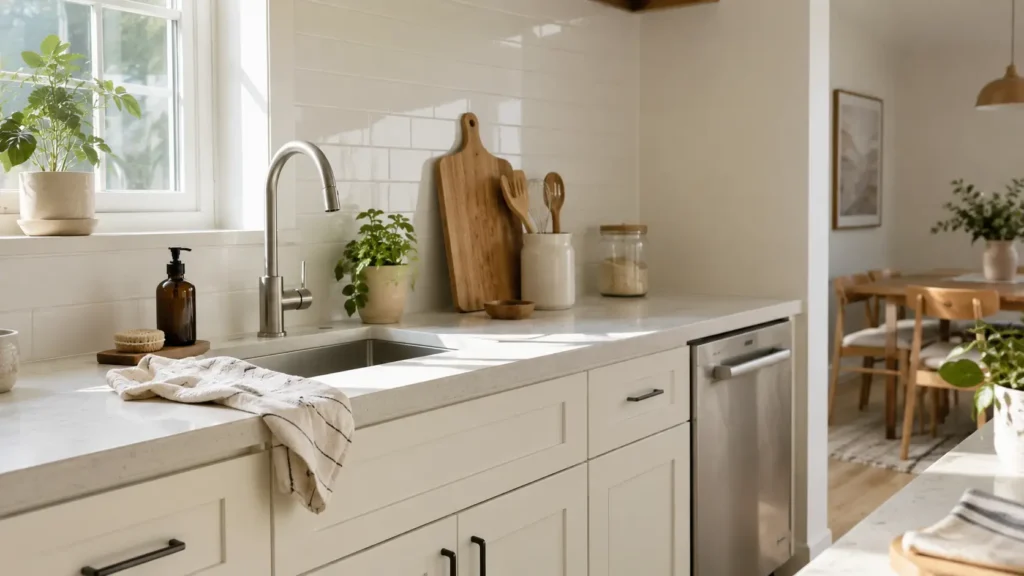
Understanding why kitchen gets dirty so fast means looking at how the space is used continuously—not just how it is cleaned.
Why Kitchen Gets Dirty So Fast
The kitchen is a high-frequency environment.
It is used repeatedly throughout the day, often in short, fragmented moments:
- preparing food
- placing items temporarily
- handling packaging
- moving objects between zones
Each action seems insignificant on its own. However, when these actions are not resolved immediately, they accumulate.
Over time, this leads to the same pattern seen in cleaning failure, where effort may exist, but stability does not follow.
The Accumulation Happens in Small Intervals
Unlike spaces that are used in longer, contained sessions, the kitchen operates in short cycles.
A surface may be used briefly and then left partially reset. Another task begins before the previous one is fully completed.
This creates a sequence of micro-interruptions:
- objects placed without being returned
- surfaces used without being cleared
- items shifting position gradually
Instead of a single disruption, the space experiences continuous, low-level change.
Why Clean Surfaces Don’t Stay Clear
Cleaning restores appearance, but it does not influence how the space is used afterward.
Once the kitchen returns to activity:
- the same surfaces receive repeated use
- items are placed in the same temporary spots
- objects move without structured return
Because of this, the environment naturally returns to disorder.
This is closely connected to how a messy home develops—through repeated patterns rather than isolated events.
Surface Overlap Creates Instability
Kitchen surfaces rarely serve a single purpose.
A countertop may simultaneously act as:
- preparation space
- storage overflow
- temporary holding area
This overlap increases the speed at which surfaces lose clarity.
This pattern is not limited to the kitchen, as explained in why your living room never stays clean, where similar surface overlap leads to repeated accumulation in other high-use areas of the home.
Instead of maintaining a defined function, the surface absorbs whatever activity occurs in the moment.
As this continues, the kitchen becomes harder to stabilize because:
- boundaries are unclear
- placement becomes inconsistent
- objects accumulate faster than they are resolved
Why Kitchen Gets Dirty So Fast Even Without Cooking
Mess is not always tied to cooking.
In many cases, it comes from movement and interruption:
- a cup left after use
- packaging placed temporarily
- utensils set aside mid-task
These actions are small and often go unnoticed. However, they create friction when repeated throughout the day.
Over time, even minimal activity produces visible disorder.
Placement Does Not Match Behavior
In many kitchens, organization is designed based on ideal structure rather than actual use.
This creates a gap:
- items are stored far from where they are used
- returning them requires extra effort
- temporary placement becomes the default
As this continues, the kitchen adapts to behavior instead of guiding it.
This shift increases the speed at which disorder forms.
Why Repetition Continues Even After Cleaning
Cleaning removes visible mess but does not change underlying patterns.
After cleaning:
- the same actions happen again
- items follow the same paths
- surfaces are used in the same way
Without a mechanism that supports how the kitchen returns to order, the cycle repeats.
This is why kitchens can feel like they require constant attention without becoming easier to maintain.
Where the Pattern Starts to Shift
A noticeable change begins when daily use aligns with how the space resets.
Instead of relying on occasional cleaning, the focus shifts to how small actions are completed.
Examples include:
- returning items immediately after use
- maintaining function-specific surfaces
- minimizing overlap between zones
A structured approach like a daily reset system helps reinforce this alignment by supporting how the kitchen returns to baseline throughout the day.
How Daily Behavior Shapes the Kitchen Over Time
The condition of a kitchen is rarely defined by one moment.
It reflects repeated patterns:
- how items are handled
- how surfaces are used
- how often small resets occur
As these patterns repeat, they shape the environment.
This explains why the kitchen can feel consistently unstable, even when cleaned regularly.
What Reduces How Fast the Kitchen Gets Dirty
Slowing down how quickly the kitchen becomes messy does not require more cleaning.
It depends on reducing unresolved actions.
This includes:
- limiting temporary placement
- reducing surface overlap
- aligning storage with actual use
When these adjustments are made, the space becomes easier to maintain—not because it is cleaner, but because it is more stable.
Conclusion
Understanding why kitchen gets dirty so fast reveals a gradual process rather than a sudden problem.
The kitchen changes through repeated daily use.
Each small action contributes to its condition.
When these actions are not supported by structure, disorder builds naturally.
When they are aligned, stability becomes easier to maintain.
Small structural adjustments in how your home resets each day can significantly reduce how quickly mess builds up over time.