Why my home never feels organized is a question that often appears after repeated attempts to clean and organize fail to produce lasting results.
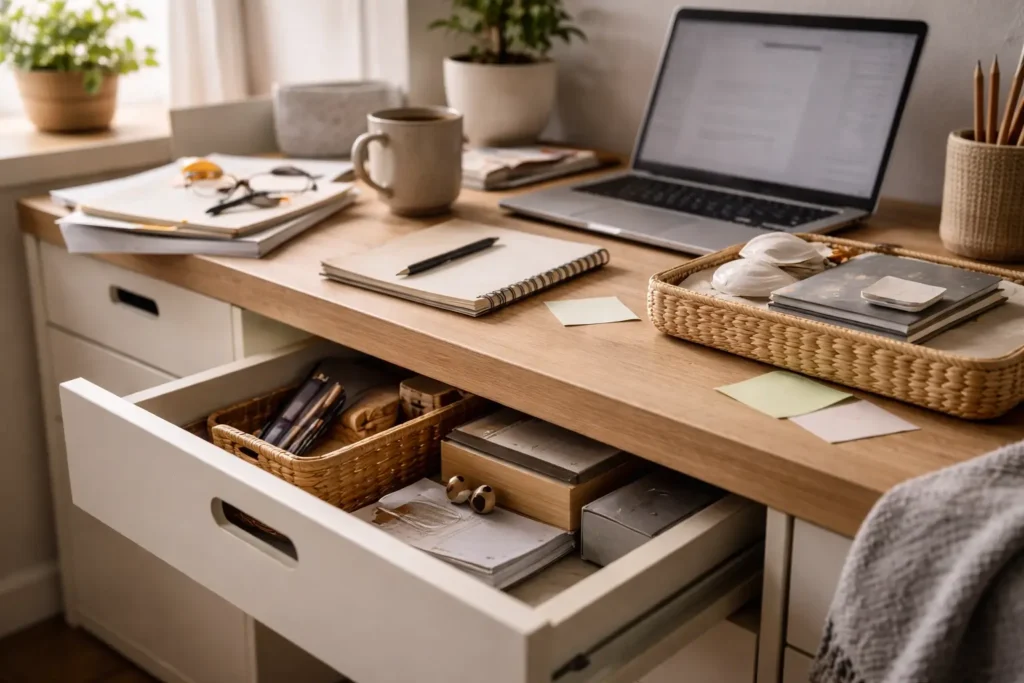
You clear surfaces.
You rearrange spaces.
You put things away.
For a moment, everything looks structured.
But the feeling doesn’t last.
Within a short time, the same sense of disorder returns.
Why My Home Never Feels Organized Even After Cleaning
Cleaning improves appearance.
But it does not define how a space functions.
After cleaning:
- items are returned temporarily
- surfaces are cleared
- visual order is restored
However, as soon as daily activity resumes, the underlying patterns remain unchanged.
This is why the feeling of organization disappears quickly.
The Difference Between Looking Organized and Being Organized
A space can look organized without being structurally organized.
Visual organization depends on:
- arrangement
- symmetry
- temporary placement
Functional organization depends on:
- consistent placement
- ease of use
- predictable return
When these are not aligned, the space appears organized but does not behave that way.
What Creates the Feeling of Disorganization
The feeling that a home is not organized is not always linked to visible clutter.
It often comes from friction.
For example:
- items don’t return easily
- storage does not match usage
- routines are interrupted
These small inconsistencies accumulate.
Over time, they create instability.
Why Reorganizing Doesn’t Fix the Problem
Reorganizing changes where things are placed.
But it does not always change how they are used.
If a system:
- requires effort to maintain
- does not match daily habits
- creates additional steps
it will gradually break down.
This is closely related to what happens in why does my house get messy so fast, where daily use naturally leads to recurring disorder.
The Hidden Role of Daily Movement
Every home has patterns of movement.
- where items are used
- where they are placed
- how often they move
When organization does not follow these patterns, friction increases.
This friction leads to:
- temporary placement
- delayed return
- inconsistent maintenance
Over time, this creates the perception that nothing stays organized.
Why the Same Areas Keep Losing Order
Certain areas tend to become disorganized faster.
These are typically:
- high-use surfaces
- transition zones
- shared spaces
Without a structure that supports constant use, these areas reset themselves in unpredictable ways.
The Structural Gap Most People Don’t Notice
The issue is rarely the absence of effort.
It is the absence of alignment.
When structure does not support behavior:
- actions require more effort
- consistency breaks
- results do not hold
This creates a cycle where organizing must be repeated.
This is closely connected to what happens when underlying patterns are not addressed, as explained in why my home never stays clean, where repeated disorder reflects how the environment interacts with daily use.
Why Effort Feels Disproportionate to Results
A common frustration is:
“I did everything, but it still doesn’t feel organized.”
This happens because effort is applied to visible outcomes rather than underlying processes.
When effort is not supported by structure:
- it produces short-term results
- it requires repetition
- it increases over time
This pattern is also described in why cleaning never lasts, where repeated effort replaces structural support instead of maintaining results.
A Practical Example
Consider a kitchen counter.
After organizing:
- items are neatly arranged
- surfaces are clear
During the day:
- items are used and left temporarily
- objects are moved without immediate return
- new items are introduced
Without a system, the counter gradually loses alignment.
A Different Way to Understand Organization
Organization is not only about placement.
It is about behavior over time.
A functional system considers:
- how items move
- how they are used
- how they return
Without this, organization becomes temporary.
A Subtle Adjustment That Changes the Dynamic
At this point, the pattern becomes clearer.
This is often where a simpler, more immediate approach can help restore control without adding pressure, as explained in how to reset your home without overwhelm, where small, focused actions create stability without trying to fix everything at once.
If your home never feels organized, it is often because the environment does not support daily activity.
Small structural adjustments can reduce this friction.
For example, aligning placement with usage or simplifying return paths can significantly improve stability.
In many cases, introducing a simple structure such as a daily reset system helps align daily use with how items return, reducing how quickly disorder builds up.
What Changes When Structure Supports Use
When structure aligns with behavior:
- actions become easier
- decisions decrease
- consistency improves
This changes how the home behaves.
Instead of drifting out of order, it stabilizes more naturally.
How to Recognize the Pattern in Your Own Space
You may be experiencing this if:
- organization does not last
- certain areas constantly reset
- maintaining order feels inconsistent
- effort does not match results
These are indicators of a structural mismatch.
Why Small Changes Matter More Than Large Reorganizations
Large reorganizations can create temporary improvement.
But small adjustments often produce more stable results.
For example:
- reducing distance between use and storage
- simplifying placement
- removing unnecessary steps
These changes reduce friction and improve consistency.
Conclusion: Why Your Home Never Feels Organized
Why my home never feels organized is not about how much effort is applied.
It is about how the space supports daily behavior.
When organization is not aligned with use:
- results do not last
- actions become inconsistent
- disorder returns
Understanding this difference changes how the problem is approached.
When organization is supported by a consistent structure, such as a daily reset system, maintaining order becomes more stable and requires less repeated effort.
If you want a simple way to apply this without overcomplicating your routine, the 5-Minute Daily Reset gives you a clear starting point you can use in your daily routine.